
Lesson Outcome
Trace the V8 engine pipeline from source code to execution: parsing to AST, Ignition bytecode generation, and TurboFan JIT optimization.
Welcome to the first lesson of your journey toward advanced JavaScript mastery. We're starting at the very foundation: the JavaScript engine itself. Specifically, we'll be demystifying the V8 engine that powers Node.js and browsers like Chrome. This lesson will trace the path your code takes from a simple text file to highly optimized machine code, covering how V8 parses, interprets, and compiles your JavaScript. Understanding this pipeline is the first step in moving from writing code that works to writing code that performs exceptionally well at scale.
Why This Matters at a Senior Level
Any developer can write JavaScript. A senior engineer understands why that JavaScript is sometimes fast and sometimes slow. The difference lies in understanding the machine. When you can reason about the V8 engine's pipeline, you stop treating performance as a black box. You can diagnose bottlenecks, write code that is friendly to the optimizer, and confidently answer deep-dive interview questions about runtime performance. This knowledge separates engineers who use the language from those who have mastered its execution environment. It is a foundational pillar for building high-performance systems and a frequent topic in senior-level interviews.
Core Concepts: From Source Code to Machine Code
Let's begin by looking at the entire V8 pipeline from a high level. At its core, V8 employs a technique called Just-In-Time (JIT) compilation, which blends the benefits of both interpreters and compilers.
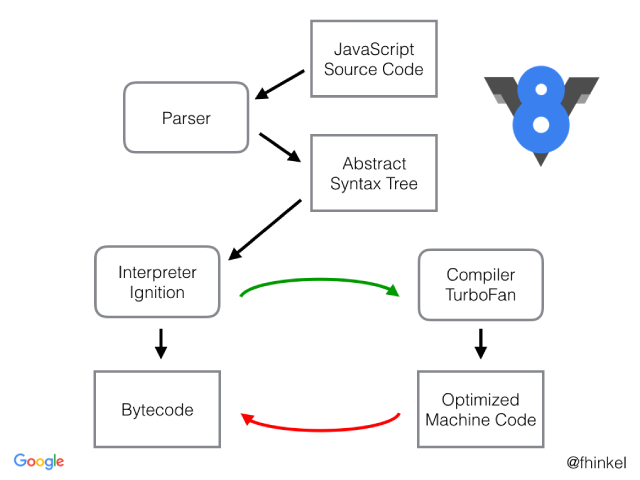
This process isn't a single step but a multi-tiered pipeline designed to balance fast startup time with peak execution speed.
1. Parsing: Creating the Blueprint
The first thing V8 does with your source code is parse it. This involves two main steps:
- Scanner/Tokenizer: Reads your code and breaks it down into individual pieces, or "tokens"
- (e.g.,
function,myFunc,(,),{,return,5,}). - Parser: Takes these tokens and builds an Abstract Syntax Tree (AST). An AST is a tree-like representation of your code's structure that the engine can understand.
For a great visual explanation of this initial process, watch the first part of this talk from the freeCodeCamp channel.
Video 1
This video, "Understanding the V8 JavaScript Engine," provides an excellent animated walkthrough of the engine's initial stages.
Guidance 2 mins
Focus on the segment from , which covers how a .js file is fetched, decoded from a byte stream, tokenized, and finally parsed into an Abstract Syntax Tree (AST).
To optimize for startup performance, V8 uses lazy parsing. It does a quick pre-parse to identify function boundaries and check for syntax errors but only does a full parse to generate an AST for a function right before it's executed for the first time. Your experience with optimizing for metrics like First Contentful Paint (FCP) shows why minimizing this initial blocking work is so critical.
2. Ignition: The Interpreter and Bytecode
Once the AST is ready, it's handed off to Ignition, V8's interpreter. Ignition's job is to traverse the AST and generate bytecode.
Bytecode is an intermediate representation of your code. It's not as low-level as machine code, but it's much more concise and faster to execute than parsing the AST every time. You can think of it as a set of instructions for a virtual machine inside V8.
The video you just watched continues with a great walkthrough of how Ignition executes this bytecode using a register machine architecture.
Video 2
Let's continue with the same video to see how bytecode works.
Guidance 3 mins
Watch the section from , where the speaker explains that the AST is sent to the Ignition interpreter, which generates and then executes bytecode. Pay close attention to the concepts of the accumulator and registers, as this is the fundamental model for how bytecode operations are performed.
If you're curious to see what this bytecode looks like yourself, you can use a special flag in Node.js. Chris Hay's video provides a very clear, hands-on demonstration.
Video 3
In this video, "How the JavaScript engine works!!", the instructor shows you how to inspect the bytecode for a simple function.
Guidance 4 mins
Watch the segment from . You'll see how to use the --print-bytecode flag in Node.js and how a simple line like return 5 translates into bytecode instructions like LdaSmi [5] (Load Small Integer 5 into Accumulator) and Return.
Executing bytecode with an interpreter is much faster than re-parsing source code, but it's still not as fast as native machine code. This is where the "JIT" part comes in.
3. TurboFan: The Optimizing Compiler
As Ignition executes bytecode, it gathers profiling data, or feedback, about how the code is behaving. For example, it tracks what types of values are passed to functions or used in operations.
If a piece of code is executed many times (it becomes "hot"), V8's optimizing JIT compiler, TurboFan, kicks in. TurboFan takes the bytecode and the feedback from Ignition and uses it to generate highly-optimized, architecture-specific machine code.
This process relies heavily on speculative optimization. Based on the feedback, TurboFan makes assumptions—or speculates—about the code. For example, if a function add(x, y) has only ever been called with numbers, TurboFan will generate optimized machine code that only handles number addition, skipping all the complex checks JavaScript's + operator normally requires for strings or objects.
For a deep and clear explanation of this process, we'll turn to a foundational article by a V8 engineer.
Reading 1
This article by Benedikt Meurer provides an expert look into how V8's compilers use feedback for optimization.
Guidance 10 minutes
First, read the section that introduces . This sets the stage.
Then, jump to the section titled "Speculative Optimization" and read from down to where the author analyzes the add(x, y) function. This explains the core idea: by assuming types (e.g., both x and y are numbers), the compiler can generate much simpler and faster code.
4. Deoptimization: The Safety Net
Speculative optimization is powerful, but what happens if the assumptions turn out to be wrong? What if, after being optimized for numbers, our add(x, y) function is suddenly called with strings?
This triggers deoptimization. The optimized machine code is discarded, and execution seamlessly reverts to the slower, more general bytecode in Ignition. The engine then continues execution from where it left off, but now has new feedback that the function can receive strings. If the function becomes hot again, TurboFan might re-optimize it with this new information.
Deoptimization is not an error; it's a crucial safety feature that makes aggressive speculation possible.
Reading 2
Let's continue with the same article to understand what happens when speculation fails.
Guidance 5 minutes
Read the two short sections starting from the header , which shows an example of optimized machine code for number addition, and the following section that demonstrates what happens when the code is then called with non-integer values, triggering .
An Introduction to Speculative Optimization in V8 · Benedikt MeurerPersonal website of Benedikt Meurer, JavaScript Engine Hacker and Programming Language Enthusiast.As you've seen, the classic Ignition/TurboFan model forms the core of V8's JIT strategy. Modern V8 has introduced even more tiers to smooth out the performance curve, but the fundamental principle remains the same.
Reading 3
This article gives a more up-to-date overview of the full pipeline.
Guidance 5 minutes
First, read the , paying close attention to the table summarizing the four main tiers: Ignition, Sparkplug, Maglev, and TurboFan. This shows how V8 manages the trade-off between compilation cost and execution speed.
Then, briefly review the "Pipeline Evolution" and "Conclusion" sections to see how this architecture has evolved over time and to get a of the key components.
V8 Engine Architecture: Parsing, Optimization, and JIT — Sujeet Jaiswal - Principal Software EngineerV8's four-tier compilation pipeline from Ignition interpreter to TurboFan optimizer — how hidden classes, inline caches, and speculative optimization achieve near-native JavaScript performance, plus Orinoco's concurrent garbage collection strategy.Mental Model: The Factory Assembly Line
Think of the V8 engine as a sophisticated factory assembly line for running your code.
- Receiving & Blueprints (Parsing): Raw materials (your JavaScript source code) arrive at the factory. The first station is the Parser, which sorts the materials and creates a detailed blueprint (the AST). This blueprint standardizes the instructions for all downstream workers.
- The General-Purpose Worker (Ignition): A versatile, jack-of-all-trades worker, Ignition, takes the blueprint (AST) and starts assembling a basic, functional version of the product by following a set of general instructions (executing bytecode). This worker is fast to start but not the most efficient for mass production. As they work, they take notes on which assembly steps are most common and what types of materials are used at each step (collecting feedback).
- The Specialist Robot (TurboFan): For products that are in high demand (hot functions), the factory manager brings in a specialized, high-speed robotic arm, TurboFan. This robot is programmed using the notes from the general worker (feedback). It makes assumptions, like "this step will always use a steel screw," and is optimized to perform that one sequence of tasks with incredible speed (optimized machine code).
- The Safety Override (Deoptimization): If a batch of materials suddenly arrives with plastic screws instead of steel ones, a sensor on the robot arm trips. The robot immediately stops (deoptimizes), and the versatile human worker (Ignition) is called back to handle this unexpected variation. The factory doesn't crash; production just slows down for that one item while the system adapts.
Conclusion
In this lesson, we've pulled back the curtain on the V8 JavaScript engine. You've learned that your code doesn't just "run"—it's transformed through a sophisticated, multi-tiered pipeline.
Key Takeaways:
- Parsing to AST: V8 first turns your source code into an Abstract Syntax Tree, a structural representation it can work with.
- Ignition & Bytecode: The Ignition interpreter walks the AST to generate and execute bytecode, a platform-independent instruction set.
- TurboFan & JIT Compilation: For frequently executed ("hot") functions, the TurboFan compiler uses feedback from Ignition to generate highly optimized, speculative machine code.
- Deoptimization: When a speculation proves wrong (e.g., a variable's type changes), V8 safely discards the optimized code and falls back to the interpreter, ensuring correctness at the cost of speed for that moment.
This entire process is a series of trade-offs between startup speed and long-term execution performance. In our next lesson, we will zoom in on the environment where all this execution takes place, exploring the two most fundamental concepts of the JavaScript runtime: the Call Stack and the Heap. We'll see how memory is allocated and managed during the execution we've just described