Lesson Outcome:
Explain how hidden classes (object shapes) work in V8 and identify code patterns that cause hidden class transitions and deoptimization.
Welcome back. In our last lesson, we established a mental model for JavaScript's memory management, distinguishing between the Call Stack for execution frames and primitives, and the Heap for objects. You now know that a variable holding an object stores a reference to a location on the Heap.
This brings up a critical performance question. If an object is just a dynamic bag of properties on the heap, how can accessing user.email be fast? A traditional dictionary or hash map lookup is relatively slow. For JavaScript to compete with lower-level languages, there must be a trick. This lesson unveils that trick: V8's system of Hidden Classes and Inline Caches. We'll explore how V8 creates "shapes" for your objects to enable near-native property access speeds, and, more importantly, how you can inadvertently write code that destroys these optimizations, leading to dramatic performance cliffs.
Why This Matters at a Senior Level
[Often asked]
Any mid-level developer can write a function that processes an array of objects. A senior engineer understands that the shape of those objects is a primary determinant of that function's performance. Knowing about hidden classes moves you from just writing correct code to writing JIT-friendly, high-performance code. In a senior interview, when you're asked "Why is this code slow?", being able to diagnose the problem as a "megamorphic inline cache due to inconsistent object shapes" is a massive differentiator. It demonstrates a deep, systems-level understanding of the runtime that is rare and highly valued. It's the key to debugging mysterious performance issues that leave others guessing.
Core Concepts: The Illusion of Dynamic Objects
Let's start with a real-world mystery that baffled a team of sharp engineers, directly from the trenches.
Reading 1
This article from The Nodebook opens with a powerful "war story" that perfectly frames the problem we're solving today.
Guidance 5 minutes
Read the story titled . Pay close attention to the cause: a single, conditional property addition that led to a 100x performance degradation. This isn't a bug in the logic; it's a conflict with the engine's optimization strategy.
How is this possible? The code was logically sound, yet performance fell off a cliff. The answer is that we weren't just adding a property to a hash map. We were violating a core assumption the V8 engine had made about our code. To understand this, we need to dismantle the myth of JavaScript objects as simple dictionaries.
The Secret: Hidden Classes (Shapes)
V8 doesn't treat your objects as slow, dictionary-like structures. To make property access fast, it pretends JavaScript has classes, similar to static languages like C++ or Java. Internally, V8 creates a Hidden Class (also called a Map or Shape) for every object. This hidden class acts as a blueprint, describing the object's layout in memory: which properties it has and, crucially, their offset from the object's base memory address.
This allows V8 to access a property with the speed of a C++ struct access: just a simple memory offset calculation, instead of a complex string-based lookup.
The diagram below provides a high-level view of where this optimization fits within the V8 engine we've been discussing. It's a key part of the JIT compilation pipeline that turns your code into highly optimized machine code.

Transition Trees: How Shapes Evolve
Hidden classes are not created randomly. V8 creates transition chains to track the evolution of object shapes.
- When you create an empty object
const obj = {}, it's assigned a base hidden class, let's call itC0. - When you add a property,
obj.x = 10, V8 creates a new hidden class,C1, and records a transition: "If you have an object with shapeC0and you add propertyx, transition to shapeC1." TheC1blueprint now knows that propertyxis at offset 0. - When you add another property,
obj.y = 20, V8 does it again, creatingC2fromC1with a new transition for propertyy.
The genius of this system is that if you create a second object and add properties in the exact same order, it will follow the exact same transition path and end up with the same final hidden class.
const obj1 = {}; // C0obj1.x = 10; // Transitions to C1obj1.y = 20; // Transitions to C2
const obj2 = {}; // C0obj2.x = 5; // Follows existing transition to C1obj2.y = 15; // Follows existing transition to C2
Now, obj1 and obj2 share the same blueprint (C2). V8 can generate highly optimized code for any function that operates on these objects because it knows their memory layout is identical.
But what if you change the order?
const obj3 = {}; // C0obj3.y = 15; // Creates a NEW transition to C3obj3.x = 5; // Creates a NEW transition to C4
Even though obj3 has the same properties as obj1 and obj2, it has a completely different hidden class (C4). To V8, it is a different shape. This is the heart of the "100x slowdown mystery."
The diagram below perfectly illustrates these branching transition paths.
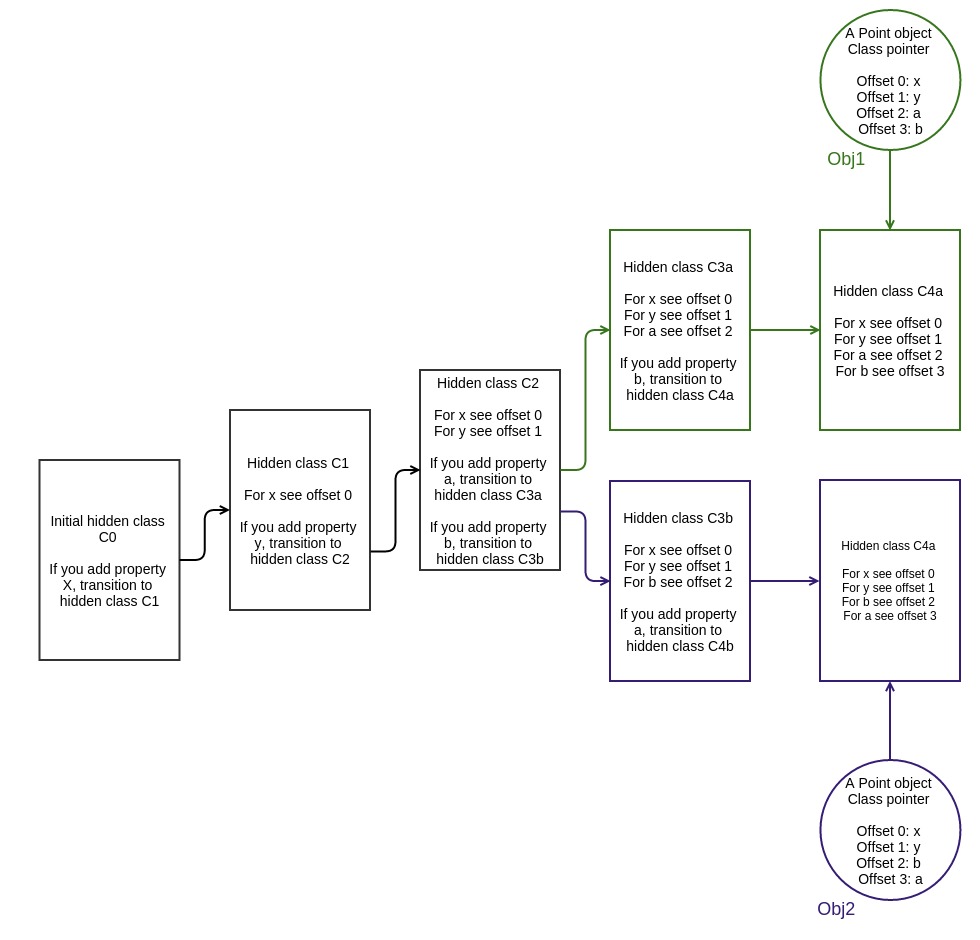
Let's dive into a more detailed explanation.
Reading 2
This article provides the canonical explanation for Hidden Classes and Transition Trees.
Guidance 10 minutes
Read the sections titled and the subsequent subsection on . This will solidify your understanding of how V8 creates and manages these internal blueprints.
Deoptimization: When the Engine Bails Out
So, V8 makes your code fast by making assumptions based on the hidden classes it sees. But what happens when those assumptions are wrong?
This is deoptimization: V8's emergency eject button. When the optimizing compiler (TurboFan) is running fast, specialized machine code that assumes an object will have shape C2, and suddenly an object with shape C4 shows up, that machine code is no longer valid. V8 must discard the optimized code and fall back to the slower, more generic interpreter (Ignition).
This is a performance disaster, especially if it happens repeatedly in a "hot loop." The engine gets stuck in a cycle of optimizing, deoptimizing, re-optimizing, and deoptimizing again.
What causes this?
- Changing property order: As we've seen, this creates different hidden classes.
- Adding properties after creation: This is especially problematic in factory functions or inside loops.
- Using
delete: Usingdelete obj.propis a performance killer. It forces the object into a slow "dictionary mode," which uses a hash map for properties and can never be optimized with hidden classes again.
Reading 3
This DEV Community article offers a very practical take on what patterns to avoid and what patterns to adopt.
Guidance 8 minutes
Focus on the sections and . These provide concrete "do" and "don't" code examples that directly map to the concepts of hidden class stability and deoptimization.
 Hidden Classes: The JavaScript performance secret that changed everythingLast week, I was profiling a Node.js service at Lingo.dev that was mysteriously slow. Chrome DevTools...
Mental Model: Object Blueprints
Think of it like this:
- A Monomorphic Object is a Prefab House: When you create thousands of objects with the same property order, you're giving V8 a single, consistent blueprint. V8 becomes an expert at navigating these houses. Accessing
obj.kitchenis instantaneous because the kitchen is always in the same place. - A Polymorphic Object is a Custom Home Development: If your function sometimes gets an object with shape A and sometimes shape B, V8 has to juggle a few different blueprints. When a delivery arrives, the driver has to first check: "Is this the 'Colonial' blueprint or the 'Ranch' blueprint?" It's slower, but manageable.
- A Megamorphic Object is Anarchic Construction: Creating objects with dozens of different shapes inside a loop is like building a city where every single house is unique and has no blueprint. To find the kitchen, you have to search room by room, every single time. This is "dictionary mode," and it's incredibly slow.
Your goal is to give V8 as few blueprints as possible for your hot code paths.
Common Misconceptions
- Myth: "JavaScript objects are hash maps." Reality: This is only their logical model and their slow fallback state ("dictionary mode"). For performance, V8 works tirelessly to treat them as fixed-layout structs via hidden classes. You fall back to hash map behavior when you break the optimizations.
- Myth: "Property order in an object literal doesn't matter." Reality: For correctness, it doesn't. For performance, it is one of the most critical factors. Inconsistent order creates different hidden classes and prevents JIT optimization.
- Myth: "
delete obj.propis the standard way to remove a property." Reality: While it is the correct way to truly remove a property, it's poison for performance on "hot" objects. In performance-sensitive code, settingobj.prop = undefinedorobj.prop = nullis vastly preferable as it preserves the object's hidden class.
Senior Insight
A mid-level developer focuses on making data transformations work correctly. They might write a function that takes an object, adds a few properties based on some logic, and passes it on.
A senior engineer thinks about the "shape" of data as it flows through the system. When designing an API response, they will ensure that arrays of objects are homogenous—all objects have the same properties in the same order. They know that the cost of doing this on the backend is trivial compared to the cost of deoptimizing a critical rendering loop on the frontend that processes that data. They write "JIT-friendly" code by default, initializing all possible object properties in constructors or factory functions, even if they are just null initially. This isn't premature optimization; it's building a stable foundation for the engine to work with.
Production War Story
The "Config Object disaster" from the article we read is the quintessential production war story for this topic. A function was creating config objects for other parts of the system.
// The problematic pattern
function createConfig(base, userOverrides, requestParams) {
  let config = { ...base }; // Good start, consistent shape

  // The problem: unpredictable property order from userOverrides
  for (const key in userOverrides) {
    config[key] = userOverrides[key];
  }

  // The killer: a conditional property addition
  if (requestParams.useNewFeature) {
    config.optionalFeature = true;
// This line forks the hidden class tree!
  }

  return config;
}
Because different users had different overrides, and the optionalFeature was sometimes present and sometimes not, this single function was generating dozens of different hidden classes. Any function downstream that consumed these config objects couldn't be optimized, because it was being fed a chaotic stream of different shapes.
The fix was to enforce a single, stable shape:
// The JIT-friendly fix
function createConfigV2(base, userOverrides, requestParams) {
  // 1. Initialize a stable shape with ALL possible properties.
  let config = {
    ...base,
    settingA: null,
    settingB: null,
    optionalFeature: false, // Always present!
  };

  // 2. UPDATE properties, don't ADD them. This preserves the shape.
  for (const key in userOverrides) {
    if (key in config) { // Important: only update known keys
      config[key] = userOverrides[key];
    }
  }

  if (requestParams.useNewFeature) {
    config.optionalFeature = true;
  }

  return config;
}
This simple change ensured that 99% of config objects shared the same hidden class, allowing V8 to generate highly optimized machine code and bringing performance back to normal.
Conclusion
We've pulled back the curtain on one of V8's most powerful optimizations. What appear to be fully dynamic objects are, under the hood, managed with a rigid system of blueprints (hidden classes) and transition paths to achieve incredible speed.
Key Takeaways:
- Objects are Not Hash Maps: V8 uses hidden classes (shapes) to give objects a fixed memory layout, enabling C-like property access speeds.
- Order is Everything: The order in which you add properties to an object defines its hidden class. Consistent order across objects is critical for performance.
- Monomorphism is King: Code that operates on a single object shape (monomorphic) is fastest. Code that handles a few shapes (polymorphic) is slower. Code that handles many shapes (megamorphic) is slowest.
- Deoptimization is the Enemy: Violating V8's assumptions (e.g., by introducing a new shape to an optimized function) causes a costly deoptimization, throwing away fast machine code.
- Write Predictable Code: Initialize all object properties in a consistent order (e.g., in a constructor or factory). Avoid adding properties dynamically and avoid
deletein hot paths.
In our last lesson, we learned where data lives (Stack vs. Heap). Now, you understand how V8 organizes that data on the Heap for maximum performance. Next, we will continue this thread by exploring another crucial optimization that builds directly on hidden classes: Inline Caching. We'll see the exact mechanism V8 uses to "remember" object shapes at specific places in your code to make repeated property access nearly free.





Comments
…
Loading comments…